

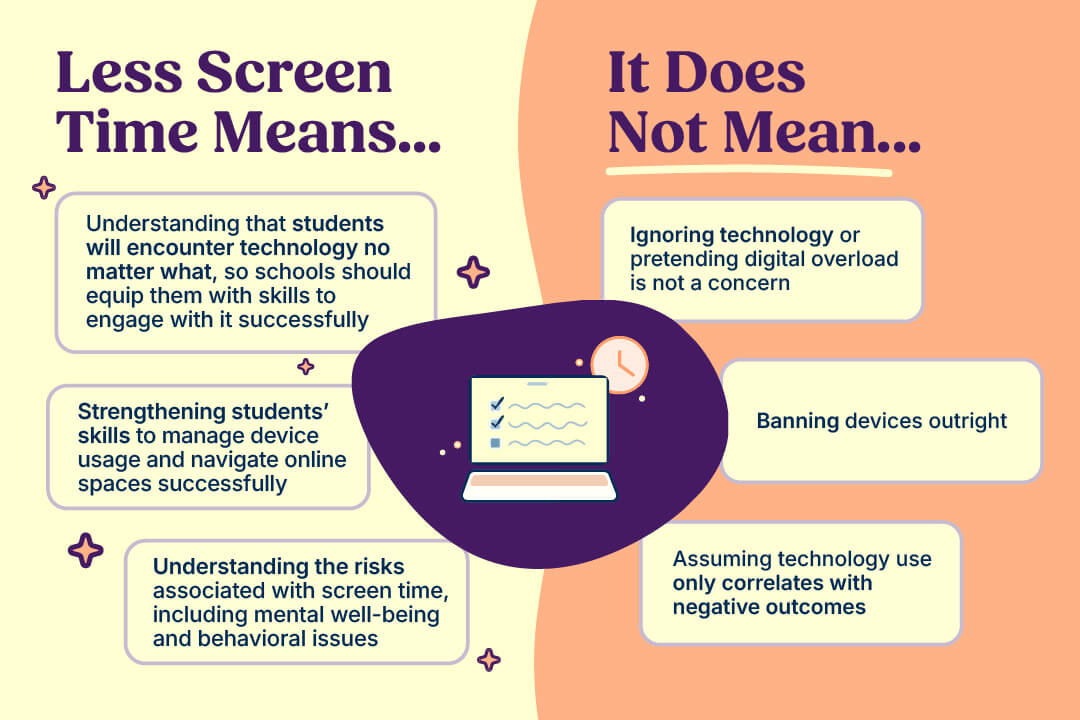
Digital well-being is a complex issue in 2026. Wanting less screen time and more human connection is about helping students connect and thrive in an era where digital devices are omnipresent. It’s not about eliminating digital device usage altogether.
This goal prioritizes strengthening the skills students need to navigate a world with technology while creating the learning conditions that make this possible. As technology advances and policies shift, a foundation of digital well-being equips students to thrive in any environment, no matter what the future holds.
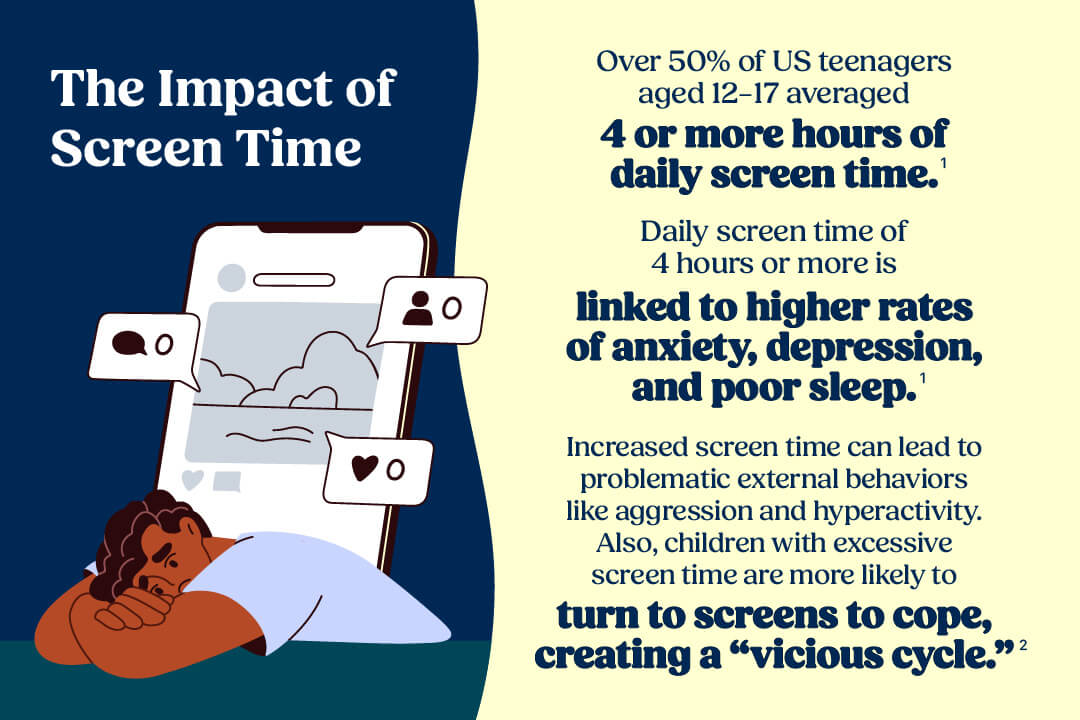
As technology becomes more prevalent and powerful, there’s increasing concern about the negative effects of excessive screen time for children, including the effects on learning.
These findings are part of a growing body of evidence associating excessive screen time to significant internal and external problems. Educators are reporting these issues in classrooms, prompting action to help students navigate an overwhelming landscape of digital technology.

Cell phone bans are only part of the solution. Learn how schools can help students balance technology use and build the digital well-being skills needed for a healthy future.

This self-assessment helps school leaders and counselors evaluate how effectively their school supports students' digital well-being through balanced technology use, healthy habits, and opportunities to build essential human skills.

The Second Step® Digital Well-Being specialized unit gives districts and schools a clear, K–12 approach to strengthening school climate by developing the human skills students need to use technology with awareness, intention, and responsibility—supporting healthier online behavior, stronger relationships, and a better focus on learning.
Watch an overview (video)
Many states, districts, and communities have different policies and approaches to these concerns, as the solution isn’t one-size-fits-all. Here’s a rundown of some important definitions and distinctions across the education landscape.
Important digital policy terms
.svg)
The law passed in 2025 restricting the use of cell phones in schools also includes a requirement for local school boards of education to adopt an internet safety policy that addresses student access to the internet on devices owned by the local board of education.
Alabama passed a law in 2026 that prohibits background television and passive screen time in early childhood education programs and requires that screen-based media in early childhood education programs not be unreasonably used as a substitute for teacher-led instruction, reading, hands-on learning, or outdoor play as well as meet the department’s screen time standards. The law requires the Department of Early Childhood Education to develop research-based guidelines on healthy screen time practices for children from birth through five years of age and to develop screen time standards for early childhood education programs that are based on current evidence-based research and practices. Screen time standards are to include (1) age-appropriate screen time limits, provided that no screen time may be allowed for students under two years of age; (2) guidelines for determining what constitutes high-quality programming (with specific factors to be considered); and (3) best practices for screen time in early childhood education programs. Additionally, the department is to develop training on screen time standards and alternatives to screen time and requires each early childhood education program teacher and staff member who closely supervises children to complete the training annually. Each local board of education is also required to adopt a screen time policy that provides guidance on the appropriate use of screen-based media in kindergarten classrooms and requires kindergarten teachers to annually complete the screen time training. Each day care center, day care home, group day care home, and night care facility is required to implement and abide by a screen time policy as a condition for licensing.
Arizona House Bill 2484 (2025)
Arizona enacted legislation in 2025 that requires each school district to prescribe policies that restrict student access to social media platforms unless allowed by teachers as necessary for educational purposes.
Florida Committee Substitute/House Bill 379 (2023)
In 2023, Florida enacted legislation that requires school districts to provide and adopt an internet safety policy for student access to the internet, which, among other provisions, prohibits and prevents students from accessing social media platforms. This legislation also amends statute about teachers’ authority to establish classroom rules of conduct to include designating an area for wireless communication devices during instructional time. This legislation also amends statute pertaining to student codes of conduct and adds that such codes of conduct include that a student may not use a wireless communication device during instructional time, except when expressly directed by a teacher solely for educational purposes and that a teacher must designate an area for wireless communication devices during instructional time.
Iowa enacted legislation in 2026 that prohibits more than 60 minutes of digital instruction per school day in kindergarten through grade 5. The legislation included the following exceptions:
1. Use required pursuant to an individualized education program or 504 plan
2. Assistive or adaptive technology used to provide a student access to instruction or to accommodate differing student abilities
3. Teacher-directed demonstrations using a projector, smartboard, or similar display device when students are not individually operating a digital device
4. State assessments, screening, progress monitoring, and local diagnostic assessments
5. Dedicated computer science and technology curriculum
The legislation also requires the board of directors of each school district to adopt a written technology use policy applicable to kindergarten through grade 5 that includes:
1. The district’s daily digital instruction limits
2. Notice of a parent’s or guardian’s right to request additional reductions in the parent’s or guardian’s child’s digital instruction
3. A statement that instructional technology shall support, not supplant, foundational learning
4. A prohibition on the use of digital devices during recess
School district boards of directors are also required to complete a technology adoption checklist prior to adopting or renewing a one-to-one digital device program for any grade level that documents certain considerations, such as age appropriateness, instructional purposes, content-filtering limitations, and student data privacy.
The department of education, in collaboration with the department of health and human services, is required to convene and provide administrative support to a working group that shall examine research related to the impact of school-provided technology on the cognitive function and academic performance of students in grades 6 through 12 and submit findings by December 31, 2026.
Maine House Print 1376, Legislative Document 2052 (2026)
In 2026, Maine enacted legislation that directs the Maine Education Policy Research Institute to develop a survey to gather and analyze information from school administrative units regarding the use of technology in the classroom, safety policies and procedures in place, and the means employed to ensure compliance with policies and procedures.
Tennessee Senate Bill 2310 (2026)
Tennessee enacted legislation in 2026 that requires each local education agency or school district serving K–5 students to adopt a policy governing the age-appropriate and instructional use of digital devices by students to minimize unnecessary screen time while preserving instructional effectiveness. Policies must (1) prioritize in-person, teacher-led instruction and the use of non-electronic instructional materials as the primary mode of instruction for students in K–5; (2) limit the use of digital devices issued by the local education agency (LEA) for students in K–5 to instructional purposes for which such use provides a clear educational benefit; (3) prohibit students in K–5 from accessing social media platforms through internet services provided by the LEA during the instructional day; (4) ensure that electronic assessments and instructional tools used by K–5 students are developmentally appropriate and aligned with state academic standards; (5) provide parents with transparency regarding the types of digital devices used by students and the instructional purposes for any such use. The legislation also clarifies that digital devices are not prohibited for certain, specified purposes.
In 2026, Utah enacted legislation that requires a local education agency (LEA) to ensure that before being used, classroom instructional technology is (1) demonstrated to have significant educational value; (2) absent of design features that interfere with learning, distract from instruction, or reduce academic focus; (3) supported by evidence, data, or demonstrated educational value appropriate to the grade level; (4) safe for a student’s physical, cognitive, and emotional development; (5) effective in supporting student learning outcomes; (6) not used as a substitute for instruction; (7) intentionally integrated into instruction to enhance student learning outcomes; and (8) compliant with state standards and law. The legislation also requires an LEA to minimize non-essential screen time; prioritize purposeful engagement with instructional technology; adopt internal monitoring and accountability policies; provide training to faculty and staff on requirements; and either adopt the model policy developed by the state board or adopt an amended version of the model policy that includes a balanced instructional technology use policy, a resource plan for students who demonstrate a pattern of difficulty learning through technology-based instruction, a requirement of transparency with parents about instructional technology use, an AI use policy similar to the model AI use policy, and a grade-level framework similar to the framework developed by the state board. Additionally, the State Board of Education is required to create a model policy on balanced technology use in the classroom. The model policy is required to prioritize developmental appropriateness and age-based limits on screen exposure; require transparency with parents regarding instructional technology use; prohibit instructional technology practices that undermine student safety, privacy, or well-being; require regular review of instructional technology; promote educator modeling of appropriate and responsible technology use; emphasize the use of adaptive technologies to support competency-based instruction; include the model AI use policy; and include a grade-level framework. The legislation also provides grade-level frameworks.
The law passed in 2025 restricting the use of cell phones in schools also includes a requirement for local school boards to deliver a course developed and approved by the state department of education to all students prior to entering eighth grade about the risks of social media and how to use social media safely.
Alabama passed legislation in 2026 that added artificial intelligence to the definition of computer science for education purposes. Beginning with the graduating class of 2032, this legislation also requires all public students to demonstrate digital literacy by earning at least one credit in a department-approved high school or college-level computer science course or by completing a department-approved course with embedded computer science skills and experiences. Existing law requires high schools and middle schools to offer instruction in computer science and requires elementary schools to offer instruction on the basics of computer science and computational thinking.
California Assembly Bill 2071 (2026)
California enacted legislation in 2026 that requires the state department of education to develop a plan to expand both mental health instruction and digital wellness instruction in schools. The plan for digital wellness instruction is required to include recommendations for age-appropriate instructional resources, strategies for keeping curriculum current with technology, guidance for schools with limited technology resources, family engagement components, assessment methods for evaluating instruction effectiveness, and strategies for ensuring support and professional development opportunities for educators regarding digital wellness topics.
Florida Committee Substitute/House Bill 379 (2023)
This legislation requires instruction for students in grades 6 through 12 on the social, emotional, and physical effects of social media.
North Carolina House Bill 959 (2025)
Legislation enacted in 2025 requires the standard course of study to include instruction on social media and its effects on health, including social, emotional, and physical effects. Such instruction is to be provided once during elementary school, once during middle school, and twice during high school. The instruction shall include: negative effects of social media on mental health, including addiction; the distribution of misinformation on social media; methods of manipulating behavior using social media; the permanency of information shared online; how to maintain personal security; how to identify cyberbullying, predatory behavior, and human trafficking on the internet; how to report suspicious behavior encountered on the internet; and personal and interpersonal skills or character education that enhances individual-level protective factors and mitigates or reduces risk-taking or harmful behavior.

Second Step programs, including the all-new Digital Well-Being specialized unit, are designed to foster human skills that help students thrive in person and online.
But students can only strengthen these skills, such as social awareness, self-management, and responsible decision-making, through intentional structures and instructional support.
According to the evidence, Second Step programs are connected with improvements in behavior, attendance, and general school climate.
These outcomes pave the way for enhanced digital well-being. When students are equipped with strong human skills and free from digital and behavioral distractions in school, they’re more focused on what matters most: learning.
In this lesson students reflect on screen time, priorities, and healthy digital balance.
References
1. Zablotsky, B., Arockiaraj, B., Haile, G., & Ng, A. E. (2024). Daily screen time among teenagers: United States, July 2021–December 2023. NCHS Data Brief, No. 513. https://doi.org/10.15620/cdc/16850
2. Vasconcellos, R. P., Sanders, T., Lonsdale, C., Parker, P., Conigrave, J., Tang, S., del Pozo Cruz, B., Biddle, S. J. H., Taylor, R., Innes-Hughes, C., Salmela-Aro, K., Vasconcellos, D., Wilhite, K., Tremaine, E., Booker, B., & Noetel, M. (2025). Electronic screen use and children’s socioemotional problems: A systematic review and meta-analysis of longitudinal studies. Psychological Bulletin, 151(5), 513–543. https://doi.org/10.1037/bul0000468