
What the Latest Evidence Says About Phone-Free Schools
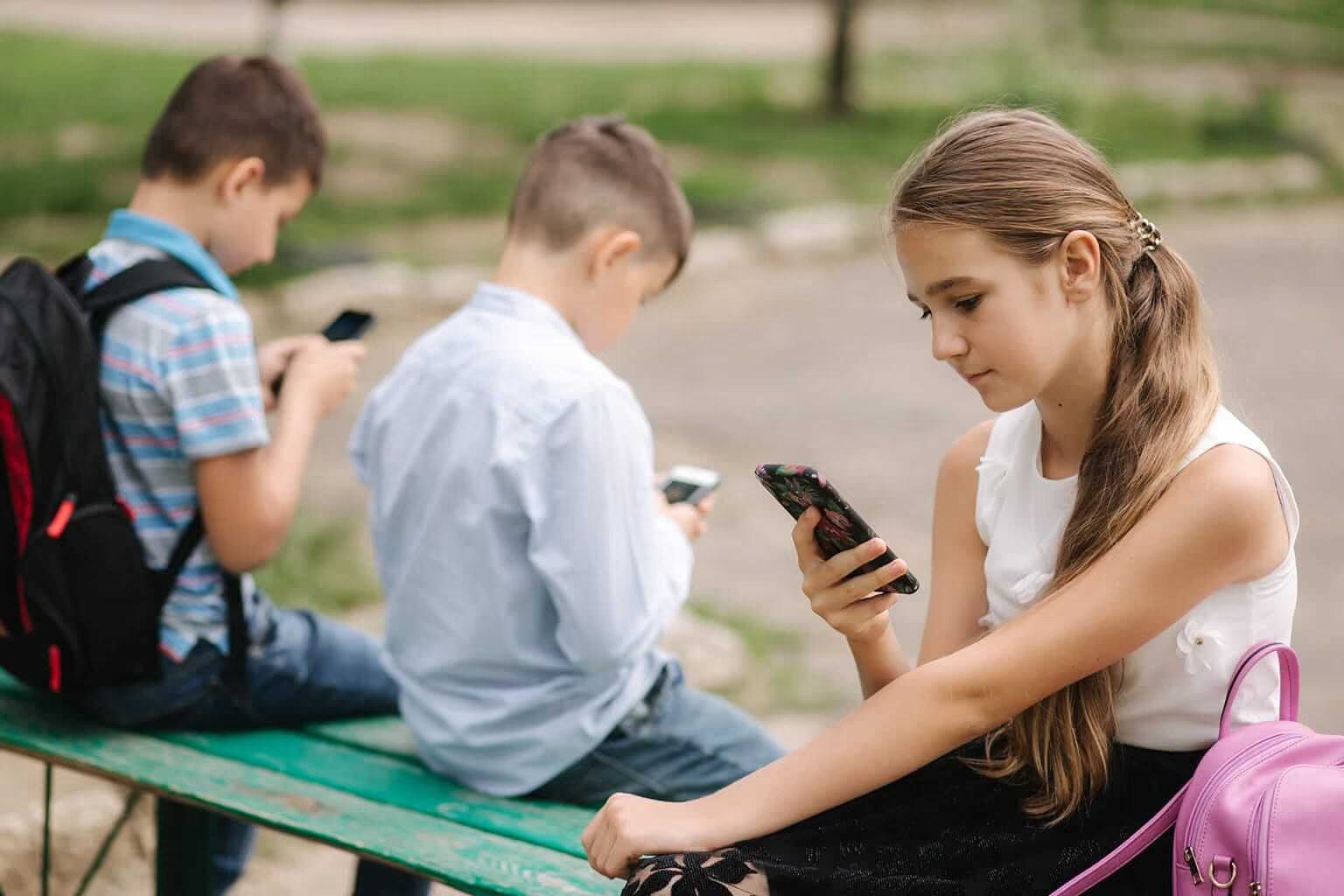
You might have seen the latest research on phone-free school policies making the rounds. A new working paper examines what happens when schools restrict student phone use. The big reveal: Bans help but aren’t a cure-all.
In the first year after adoption, schools tend to experience more disciplinary incidents and a decline in students’ subjective well-being. That’s consistent with what many educators might expect. If we take away a deeply embedded part of students’ daily lives, we should expect short-term disruption.
The longer-term picture is more nuanced. Over time, student well-being improves, and disciplinary effects taper off. Academically, the results are modest: average test score impacts hover near zero, with some variation across grade levels. High schools appear to see small gains, especially in math, while middle schools sometimes show slight declines. Meanwhile, attendance, classroom attention, and perceived online bullying remain largely unchanged.
As an interesting side note, other research, particularly from Europe, suggests that phone restrictions can lead to academic improvements, especially for disadvantaged students. Perhaps reducing distractions disproportionately benefits those who have fewer external supports for focused learning.
So what should we take from all of this?
1. Bans alone are not enough
Removing phones changes the environment, but it doesn’t automatically build the skills students need to thrive in that environment.
A phone-free policy is, by definition, a negative intervention. It removes a stimulus. That creates an opportunity for better focus and stronger in-person interactions, but it doesn’t teach students how to navigate that opportunity particularly well. Without additional support, students might initially struggle to adjust, which likely explains the early increase in disciplinary incidents and dip in well-being.
2. Better to pair restriction with skill-building
About a year ago, we suggested that phone-free policies could help schools reclaim something increasingly scarce: sustained attention and meaningful, in-person relationships. This still seems to be the case.
The research surrounding phone-free schools strengthens a key addition to that view: balance matters.
If we want better outcomes, we shouldn’t think of phone bans as the solution. Instead, we should see them as one component of a broader strategy.
Pairing a negative intervention (less access to phones) with a positive intervention (explicit instruction in digital well-being and human skills) is where the most promising opportunity lies. Why? Because students need to learn:
- How to manage attention and resist distractions
- How to build and sustain real-world relationships
- How to navigate emotions without defaulting to digital escape
- How to use technology intentionally rather than habitually
3. The evidence base for digital well-being education is growing
We’re encouraged by the growing body of research around digital well-being. Research suggests that building self-regulation, communication skills, and intentional technology use supports both learning and well-being outcomes.
In other words, if phone bans create the conditions for improvement, digital well-being education provides the tools.
Together, they’re far more likely to produce the outcomes schools are aiming for: better focus, healthier relationships, stronger student well-being, better overall school climate.
4. Moving forward: From debate to design
The conversation around phone-free schools often gets framed as a debate: Should schools ban phones or not? The emerging evidence suggests a better framing:
What environments do we think are best for students to learn in? What skills pair best with those environments?
For the issue at hand, bans plus well-being skills seem like the best answer to date.
Reach out for a free consultation to discover how Second Step® human skills programs can help the students in your district develop key skills for school, work, and beyond. Also, be sure to ask about our new Digital Well-Being specialized unit.
Recent Posts

Always On but Never Connected: The Digital Divide Between Students

5 Tips to Maximize Student Outcomes Through Second Step® Program Data